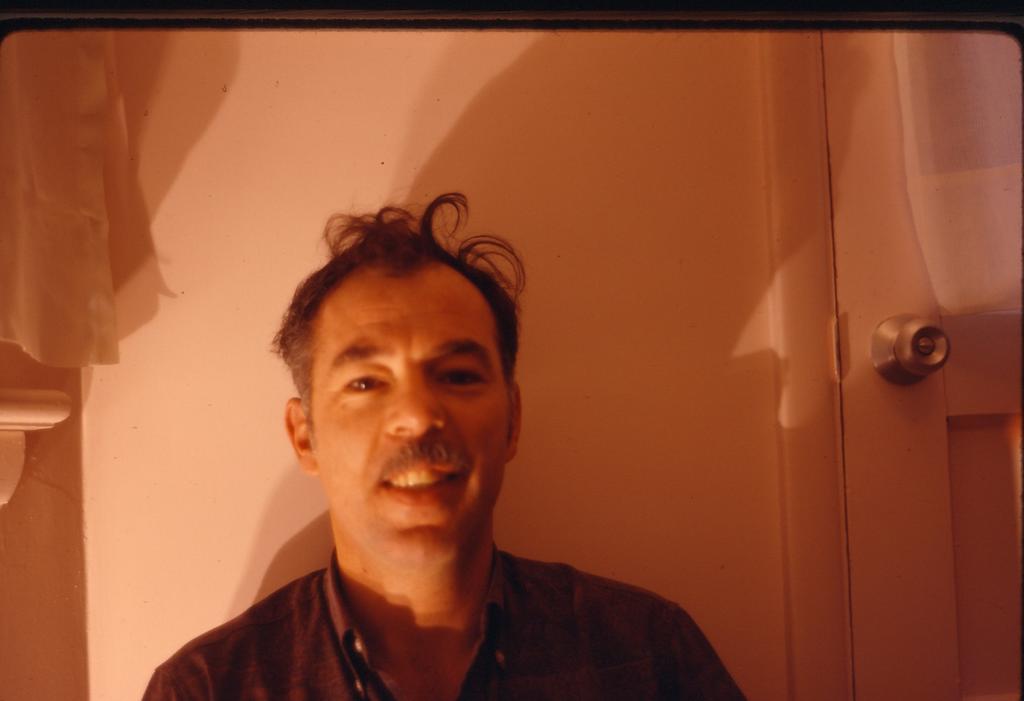
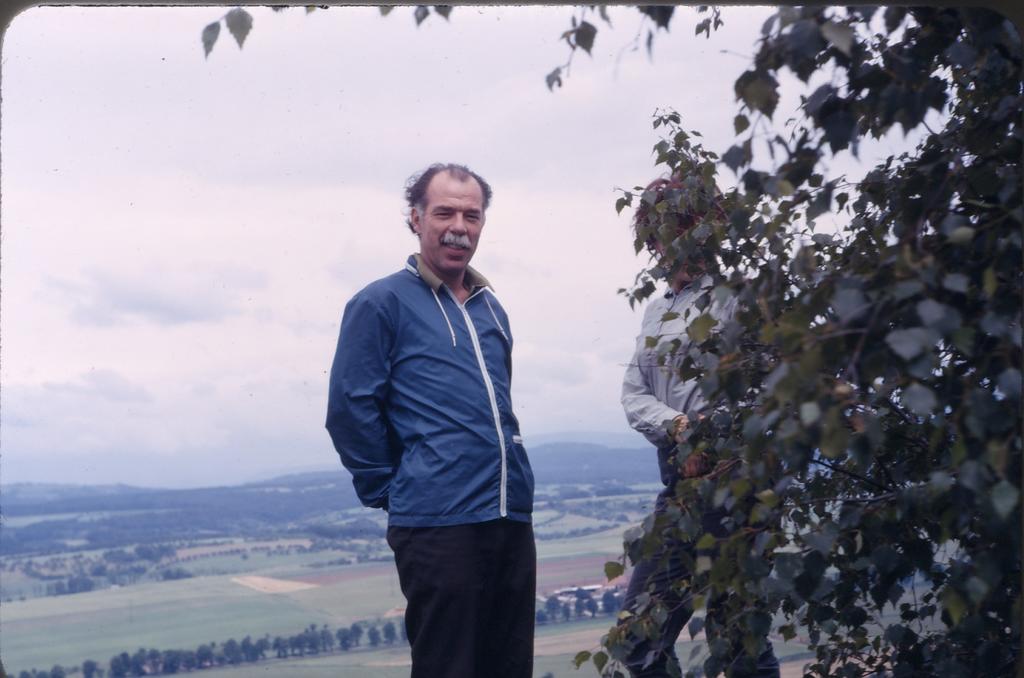
Saturday, August 13, 2005

Photos: Dad, our bomb shelter at Hamra, 1971
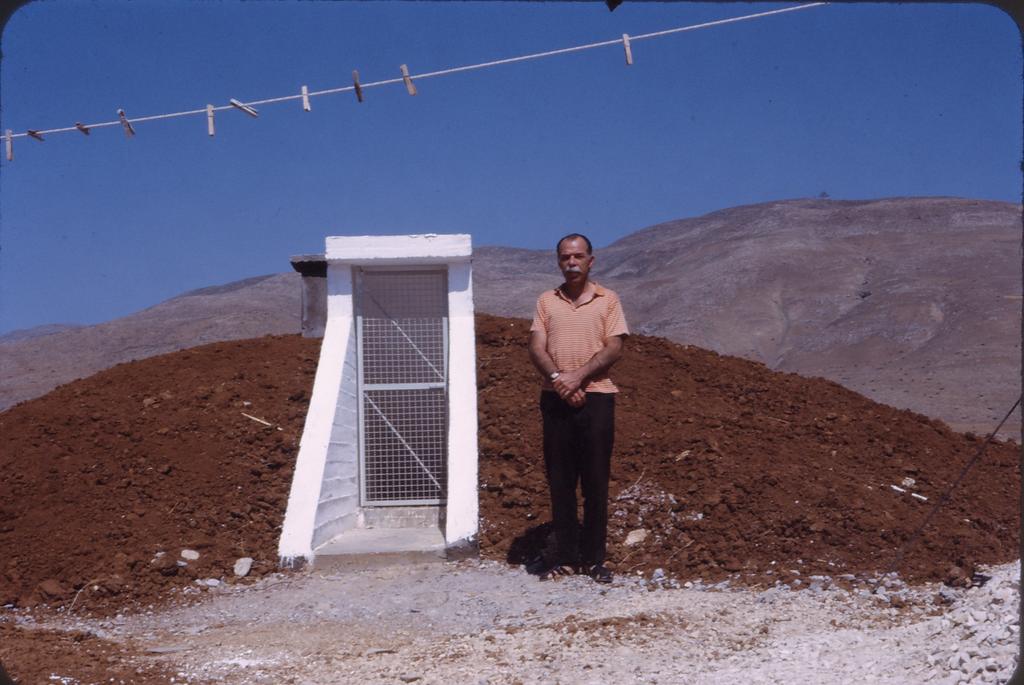
Photos: Dad in the Kitchen 1967

Monday, August 01, 2005

Photos: Mom on Kinneret, Tiveria, July 20 1971

Photos: Dad in Tiveria July 19, 1971

Saturday, March 15, 2003

(liza) Cleaning Cancer From My Ipaq

Hi Dad.

I'm trying to clean things up.
My office, the stacks and stacks of papers, cancer papers. Cancer everywhere.
Cleaning up my palm pilot, found this.
Guess I can delete this now, guess I don't need to keep this on hand anymore, guess I won't be needing to have it right here to, to, to tell doctors, to tell someone, to get help from someone, to have it here if we need it, to help you, we don't need it, you're gone, I can't help you anymore.
You're gone.
So I'm taking it off my palm pilot.

CANCER HISTORY
Tumor removed from caecum 3/00
Second surgery to remove impaction and adhesions 8/00;
Right lobe of liver removed 3/01
5FU+leuk weekly low-dose 4/01- 8/01
PET 9/01 shows 2 liver mets 8 and 10 mm
CPT-11 11/01 - 1/10/02 (much nausea, vomiting and fatigue)
CT 1/08/02 shows liver mets increased to 2.1 cm and 2.3 cm
CT 2/17/02 shows 2 new mets 1 cm each, old mets now increased to 3.5 cm
RFA Cleveland Clinic Dr. Siperstein to ablate 4 mets 2/20/02
CT post-op shows a fifth previously undetected 1.2 cm met left intact
CT 04/02 shows many new mets in liver, tiny mets now seen in lung also
Xeloda plus Celebrex started 04/02
Hospitalization 05/02 for severe vomiting, diahhrrhheehaa
CT 06/02 shows many new liver metastases - two are now 5 and 6 cm
CT 7/22/02 shows significant progression - more mets, two biggest
now 8 cm. Lung mets have spread, biggest now 3.5 cm.
Oxaliplatin/5FU started 9/20/02
Medi-Port installed 9/19/02: Versed 2.5 mg; Fentanyl 150 mg
9/20 - first infusion
zofran, decadron
ativan 1 mg
atvan 5 mg
Oxali 147.05 mg over 2hrs.
Leucovorin 346 mg over 2 hrs.
5-fu 692 mg bolus
5-fu 4152 mg over 46 hrs.
Home:
Zofran and Decadron
Ativan or Ambien
Prevacid
Reglan
Levaquin
Lactulose as needed

Wednesday, March 12, 2003

(liza) Mom's Birthday

Oh, Dad.
It's her 79th birthday tomorrow.
We'll be spending it in the ICU I guess.

(liza) Mom's in the hospital

Dad, Mom's in the hospital.
Intensive Care Unit.
They think she's had a small stroke.
She had an MRI, no clots there now, but scar tissue from previous small strokes.
She has high blood pressure and cholesterol, she's on heavy drugs for both.
Doctor wants to keep her there for a few days, says he's worried she might have another real stroke.
Oh.
Back in the hospital again.
Oh.

Monday, March 10, 2003

Dad I finally saw "Diamond Men" last night - remember we were waiting and waiting, for two years, for it to come out on video or dvd? You wouldn't have liked it. I loved it, but you wouldn't have liked it because there was sex in it. You wouldn't have been able to appreciate wonderful Robert Forster, his quietness, his perfect Jewishness, his Baltimore-ishness - because you'd be uncomfortable that this was a story about sex. It wasn't a story about sex. But you wouldnta liked it, I know.

So you didn't miss anything.

Sunday, March 09, 2003

Dad pronounced "huge" like this: "You-oooo-jjjj."
Dad was soooo Jewish.

Thursday, December 19, 2002

Arlene and Mike Scadron say Goodbye to Dad

Dear Anita and Family,

We were so sorry to hear of Earl’s death last week. He was an extraordinary person, as anyone who spent even five minutes with him would realize. Although geographical distance limited the times we had together, our memories and experiences with Earl were special. We shall never forget him.

Those memories and connections extend all the way back to World War II, when the Callen family, and Arlene’s family, the Weiningers, first met in Philadelphia. Earl’s parents, Mildred and Abe Callen, kindly took Arlene’s father, Mandel Weininger, a young naval officer stationed at the Philadelphia Naval Yard in 1944, under their wing. They invited him to Friday night dinners, mitigated some of the loneliness of his life, and most important, opened their home to Minnette, Marc and Arlene “Pudgy” Weininger, when they traveled from Chicago to visit their husband and father. In the years following World War II, Mildred and Arlene’s mother, Minnette, continued their friendship, mainly through correspondence and occasional visits.

In the meantime, Earl and his brother Herb grew up and became physicists. And Arlene also grew up and married a young physicist, Mike Scadron. In 1966, when Earl and his family took a sabbatical near Osaka, Japan, Mike and Arlene, en route to London via Asia, visited them and rejuvenated the previous generation’s family ties, now strengthened by mutual professional interests. Then in 1968, Mike took his first academic job at Northwestern University, hired by Art Freeman, a contemporary of Earl and Herb at MIT.

Then in the late 1970s, Mike asked Earl to travel around the world interviewing potential physics graduate students as part of the Physics Interviewing Project. Earl survived the hazards of spicy food, crummy hotels, and all-day interviews, and he and Mike published an article about the project entitled, “Observations on an Obstacle Course,” or something like that. Over the intervening years, we met occasionally in Washington, and once in Tucson, but our mutual interest in Asia brought us together again in Tokyo in 1988. Earl had retired from American University and was working for the U.S. Navy, picking the brains of Japanese physicists. Living like semi-royalty in the heart of the city, Earl invited us to share his space (about 500 sq. ft.) while Anita was visiting Washington. He took us to his favorite places, including wonderful little dives, where you could eat, drink and absorb the atmosphere for a few yen. As usual, his enthusiasm for the country, his capacity to absorb and learn about a profoundly different culture, and his newfound passion for dancing, were infectious.

We were lucky enough to see Earl and Anita in Chevy Chase in 1995, when they shared their home with us for about a week. Again, in the summer of 2001, Arlene spent an evening with Earl and Anita. Sadly, that was to be the last time we saw Earl, but despite his illness, his determination to complete a personal memoir and his interest in public affairs stood out. Even when he was already battling cancer, and the Washington summer heat was sufficiently unbearable to put most men into a chair sipping lemonade, he took to the tennis courts, practicing his recently found passion.

Earl was an unusual person who loved life and lived it fully--with devotion and deep commitment to his family, to physics, to major issues of public policy. He cared deeply about everything he chose to do. We doubt if we will meet anyone quite like him again.

To express our profound sympathy for Earl’s passing and to honor his memory, Mike and Arlene Scadron and Minnette Weininger are sending a contribution to the Dr. Earl Robert Callen Scholarship Fund at American University.

Love and best wishes,

Arlene and Mike
Tucson, AZ 85716


Wednesday, December 18, 2002

Eric Levin on Liza's Eulogy

Dear Liza: This is terrific. Wonderful. Thank you so much. I am going to forward it to Chip, too.

Hanukah or Passover is a great idea. I would love to help make it happen. Lisa and Larry and their kids are, as it happens, coming to New York for Passover and will join us for the second seder. If you would like to join us, we would be delighted. I realize that may not be practical, it being your first Passover without your dad. But the invitation is there, and we can work on the other thing.

By the way, when I got back home I was thinking about Earl and I wrote this paragraph. I doesn't say anything not said at the service, but if you're doing a scrapbook of memories, maybe it will fit in somewhere:

My father and I were on our way to Washington to attend a memorial service for my father's first cousin, Earl, who had just died of cancer at 77. Earl was a remarkable man. A distinguished physicist, a social activist, a professor, a professed atheist who was nonetheless a chauvinistic Jew, a savvy realist who was nonetheless an eternal optimist. He looked like an alert rabbit, his bright eyes, all the lines of his eager face, tapering toward the tip of his nose, under which twitched an enormous bushy mustache. His enthusiasm for life was boundless. He was an accomplished square dancer, contra dancer and line dancer. On him, a straw hat looked dashing and fun. Everyone loved him. He was a collector of jokes, a teller of stories and a keen, responsive listener. He just naturally made everyone around him feel welcome and appreciated and good -- funnier, smarter, more accomplished than usual -- and yet he was often the funniest, smartest, most accomplished person in the room. He played tennis almost to the end. His tennis partners marveled at his ability to come directly from a chemo session to the court, where he would display all his customary competitive gusto and sporting goodwill.

Eric Levin
Montclair, New Jersey

Dear Jed, Eric, and Lisa

Dear Cousins,

It was very wonderful to see you last week. Dad loved you so very much, and I do too. Thank you for coming such a long way, and for being family.

Thank you also for the nice things you said to me about my eulogy. I'm glad you liked it.

I hope we'll have reasons to keep seeing each other. Dad's very last request of me was if I would promise to conduct Pesach and Hannukah next year - he said, "Liza I don't think I'll be able to do it this year, no, I don't think so, but Liza would you do Pesach and Hannukah for me next year? The way we planned it?" and I said "Yes Dad, I promise I will do it next year, and every year after."

So maybe we can get ourselves together for the holidays? I'd love that. So would Dad.

In any case, let's keep in touch. And thank you all again for your love and kindness.

Lots of love,

Liza

Friday, December 13, 2002

Eulogy

DAD, August 28, 1925 – December 9, 2002


Dad was unique.

Every person is unique of course. But Dad was a little uniquer than most.

Dad was a nonconformist - an independent thinker. He had this HUGE gusto for life. And boy oh boy did he know how to have fun!

Dad loved music. My childhood memories are filled with song.

I remember Melany sliding around up on Dad’s shoulders, and Mom and me following around behind them, all of us marching round and round the pink bedroom in our pajamas. Mom playing trumpet with her hand - like this - singing “We Belong To The Mu-tu-a-a-a-a-l Admiration Society, My Baby And Me…..”

We’d go on camping trips, always singing in the car - rounds, harmonies, folksongs. Dad, Melany, and I could do a mean "Hoist Up The Sloop John B" in three-part harmony.

We had a pink rambler station wagon. She had a name: “Rose.” Dad would throw some army blankets - our only camping equipment - in the back of Rose, and take us driving out into the country. Once we sneaked Rose into someone’s private woods with what must have been a very extraordinarily cheap piece of steak Dad had bought; we dug a hole in the dirt, lit a teensy weensy fire with some sticks, and then sat there for hours into the night staring at our wee little fire and our raw steak, going weak with hunger, and singing and singing. Dad told us this particular type of steak is called "Bubblegum Steak" because you have to gnaw on a piece for hours to get it soft enough to swallow it.

Everyone in this room knows that Dad loved to dance! And he was a good lead! He would get all dolled up in his elegant suits - which cost a full $1.50 - which Mom would have found for him at the thrift store – because Dad and Mom love a great bargain – and he would look like a turn-of-the-century dapper dandy dancing chap. And his big straw hats! Dad loved hats.

And Dad loved words. Stories, wit, quotations, jokes - especially Jewish jokes. And poetry. He loved poetry. This poem will always remind me of Dad:

THERE'S a barrel-organ carolling across a golden street
In the City as the sun sinks low;
And the music's not immortal; but the world has made it sweet
And fulfilled it with the sunset glow;
And it pulses through the pleasures of the City and the pain
That surround the singing organ like a large eternal light;
And they've given it a glory and a part to play again
In the Symphony that rules the day and night.

Dad loved a story, and could make one up without any effort. Dad and I went to see a lot of movies together, and he loved the movies that told a great story. I love character, but Dad has always loved a good plot. Once we were sitting in the theater waiting for the lights to go down, and I asked him HOW he managed to just come up with these wonderful stories of his that he'd make up, and he said, "Well I just open my mouth and start talking and a story comes out. " He himself had no idea where it would go or what would happen next, and he wanted to keep telling so he could find out.

Dad didn't get the Sunday paper. He thought it was inferior. And it was too thick, anyway. But every Sunday morning he would call me so I could read him the Style Invitational - my favorite part of the Washington Post – a weekly humor contest. And WOW would we get laugh on Sunday mornings! Dad's favorite contest was the one where you had to come up with the WORST metaphor in order to win.

His favorite worst metaphors were:

"Her hair glistened in the rain like nose hair after a sneeze."

"The little boat gently drifted across the pond exactly the way a bowling ball wouldn't."

"John and Mary had never met. They were like two hummingbirds who had also never met."

And this was his favorite ... I don't know why it got to him, maybe because it was like physics, but this one cracked him up:

"His thoughts tumbled in his head, making and breaking alliances like underpants in a dryer without Cling Free."

Dad loved to talk. About politics, the world, art, movies, books, people, food, music, and microscopic bdelloid rotifers that you can boil for an hour or freeze to within 1 degree of absolute zero - and they do not die!! They dehydrate themselves!! and turn into tiny specks!! and blow about the globe as dust so easily that they blow back and forth between Africa and America!! And - there are no male bdelloid rotifers! Every single member of five hundred species of bdelloid in the world is female!! Bdelloid rotifers reproduce without sex! For 80 million years bdelloid rotifers have been reproducing without sex!! Dad would talk about the wonders of nature, the wonders of life.

Dad cared deeply about the Jewish people. I am so glad that Dad came to visit us in Israel and lived in the house next door on our moshav, and that he was able to get a taste of Israel in it's heyday. Dad was worried we might lose Israel. I am too. It took 18 centuries from the Bar Kochba revolt in 135 CE all the way to 1948 for there to be a political Jewish entity again, and it’s existence seems so tenuous now. I am so glad for Dad that he had a chance to see an Israel during his lifetime.

Dad and I would wonder together what it is about Jewish theory (and sorry Dad wherever you are out there, but Jewish "theory" is Jewish religion, hate to say it) but what exactly is so compelling about the culture that allows it to survive devastation of entire civilizations of Jews disappearing forever into history - and yet the theory still persists and revives itself again and again? We will have to wonder about this ourselves now, without Dad's thoughtful insight and help.

Dad was an atheist. And he was a deeply spiritual man. He was both those things.

I remember the first time I came home from school and asked him if there was a God. WOW! Did he explode. "Is there a WHALE in that lightbulb?? How do you KNOW???"

But I kept asking him and asking him, again and again, over the years. And I asked him again last year. I said, “Dad, I wonder about the idea of God,” and he said "I know you do dear." And he finally gave me the answer I'd been waiting to hear all my life.

He said, “I tell people I'm an atheist, because people need to hear simple black and white answers to complex questions. And as a physicist I would say that everything I can measure and understand about the universe tells me that for all practical purposes there simply is no evidence of any supernatural force or intelligence. But the truth is that I do not KNOW what I do NOT know. I only know what I CAN know. So how can I know if there is not something BEYOND what I can conceive of or understand? How do I know God is NOT out there, and has created this universe for me to study and examine, and is toying with me? So the truth is that I don't know if there is a God or not. I will say I'm an atheist, because the God that most people believe in seems like nonsense to me. But the truth, Liza, is that I am not an atheist. I don't really know if there is a God, or not, and what God might possibly be.”

Dad loved his family, but he loved Mom most of all. He told me that in all the world, there was no person with whom he shared so precisely the same viewpoint on people, and on life, as he did with Mom.

Dad's cancer progressed rapidly, sapping his strength, but never his spirit. Dad had five miserable surgeries, suffered through six different chemo regimens, and was in and out of the hospital, often heavily medicated for pain. I decided - on that first shocking day when Dad called with the terrible news of his diagnosis – that whatever struggles or horrors lay ahead - I would not let him face it alone.

What I didn't realize is the incredible richness I would get from these two years of such intense closeness with my father. I feel so lucky to have had this close, close time with him. I feel lucky to have had fifty years of closeness with Dad. So very much love between us.

Dad, this is for you:

O world, I cannot hold thee close enough!
Thy winds, thy wide grey skies!
Thy mists, that roll and rise!
Thy woods, this autumn day, that ache and sag
And all but cry with colour! That gaunt crag
To crush! To lift the lean of that black bluff!
World, World, I cannot get thee close enough!

Long have I known a glory in it all,
But never knew I this:
Here such a passion is
As stretcheth me apart. --Lord, I do fear
Thou'st made the world too beautiful this year;
My soul is all but out of me, --let fall
No burning leaf; prithee, let no bird call.

Dad told Mom that he wanted his death to be a class act. Dad, wherever you are, it was a class act. You were a class act Dad. Thank you for your life Dad! You were - and are - an inspiration.

Saturday, November 02, 2002

(liza) Re: Searching for the Dog Book

Hi Dad,

November 30th is great. Next week I'll come over on whatever day you're free to work on Lydia Pinkham Pinkham Pinkham, and I'll bring the sheet music I've written up for Frank (I faxed it to him too). I sure am looking forward to the show - what fun it will be! I'm most looking forward to Jane and Nick's play - that is SO cool that they've actually written a play! It's inspiring. Can't wait to see it. Now I want to write a play too!

Last night I saw "Baran" - new Iranian film about Afghan refugees there - it was in the theaters here about three months ago and got good reviews. I wasn't impressed. It wasn't bad, but it wasn't great. By the director of Children of Heaven.

I have a book I want to read to you. It is SO much fun. It's called "A Walk In The Woods" about hiking the Appalachian Trail. I'll check it out of the library and bring it over when I come, to read a chapter or two or twenty.

Love Liza

(dad) Re: Searching for the Dog Book

That doesn't sound right. It was not a gorgeous book; it was a simple
little school book. And it was not quaint and old fashioned. It was a
simple kid's story about summer and mommy and two little children
picking berries.

Our Hanukkah party will be on Saturday evening, November 30. Good!

Love Daddy

(liza) Searching for the Dog Book

Dad, I don't think this is probably it, but thought I'd try anyway.
This is evidenly a gorgeous book, published in 1901, one of a series by Elsa Beskow.
Is it the one you read? I'll keep looking! We'll find it!!
Love Liza

Sunday, September 01, 2002

Dad Rants about Republicans

It's always been lies and hypocrisy. Who dies in the trenches in every
war? Generals? They get congressional awards, promotions and fame. Who
has always made money and controlled the tax laws to soak the middle
class and keep from paying taxes? Not the middle class. Nothing has
changed. What Bush and the whole monied class is determined to do once
again for Wall Street is to go after the minimum number of exposed
culprits, build up confidence that it is clean now and bring the suckers
back in. dad

Sunday, June 02, 2002

Shakespeare's Cat

Hamlet's Cat's Soliloquy
From HAMLET'S CAT
By William Shakespeare's Cat

To go outside, and there perchance to stay
Or to remain within: that is the question:
Whether 'tis better for a cat to suffer
The cuffs and buffets of inclement weather
That Nature rains on those who roam abroad,
Or take a nap upon a scrap of carpet,
And so by dozing melt the solid hours
That clog the clock's bright gears with sullen time
And stall the dinner bell.
To sit, to stare Outdoors, and by a stare to seem to state
A wish to venture forth without delay,
Then when the portal's opened up, to stand
As if transfixed by doubt.
To prowl; to sleep;
To choose not knowing when we may once more
Our readmittance gain: aye, there's the hairball;
for if a paw were shaped to turn a knob,
Or work a lock or slip a window-catch,
And going out and coming in were made
As simple as the breaking of a bowl,
What cat would bear the household's petty plaq
ues,
The cook's well-practiced kicks, the butler's broom,
The infant's careless pokes, the tickled ears,
The trampled tail, and all the daily shocks
That fur is heir to, when, of his own free will,
He might his exodus or entrance make
With a mere mitten?
Who would spaniels fear,
Or strays trespassing from a neighbor's yard.
But that the dread of our unheeded cries
And scratches at a barricaded door
No claw can open up, dispels our nerve
And makes us rather bear our human' faults
Than run away to unguessed miseries?
Thus caution doth make house cats of us all;
and thus the bristling hair of resolution
Is softened up with the pale brush of thought.
And since our choices hinge on weighty things,
We pause upon the threshold of decision.


OTHER TITLES IN THE SERIES
"POETRY FOR CATS"

The Prologue to TERRITORY LOST by John Milton's Cat
MONGREL! MONGREL! BARKING BLIGHT by William Blake's Cat
KUBLA KAT by Samuel Taylor Coleridge's Cat
THE END OF THE RAVEN by Edgar Allen
Poe's Cat
"Meow of Myself" from LEAVES OF CATNIP by Walt Whitman's Cat
THERE IS NO CAT-TOY LIKE A MOUSE by Emily Dickinson's Cat
TREED by Joyce Kilmer's Cat
DO NOT GO PEACEABLE TO THAT DAMN VET by Dylan Thomas's Cat
MEOWL by Allen Ginsberg's Cat

Thursday, May 30, 2002

(Dad) Genentech Number Four

From: Earl Callen [mailto:earlcallen@yahoo.com]
Sent: Thursday, May 30, 2002 1:42 PM
To: Liza May
Subject: Re: Genentech Number Four

HEY! Right here in Kensington! This sounds good
to me. What do you think? dad


--- Liza May wrote:
> Dad, this is a multi-center trial, and from
> this it appears there is a
> Kensington location participating!!
> Love Liza
>
> Trial: Avastin (rhuMAb VEGF) plus chemotherapy
> in patients with metastatic
> colorectal cancer
>
>
> Maryland Locations:
>
> Baltimore, MD 21204 - Greater Baltimore Cancer
> Center
>
> Kensington, MD 20895 - Associates in
> Oncology/Hematology, PC
>
> Rockville, MD 20850 - Associates in
> Oncology/Hematology, PC
>
> Westminister, MD 21157 - Carroll County
> Cancer Center
>
>
>
> Rationale: rhuMAb VEGF (bevacizumab) is an
> experimental, humanized
> monoclonal antibody produced by Genentech,
> Inc., using recombinant DNA
> technology. rhuMAb VEGF is an antibody directed
> against vascular endothelial
> growth factor, or VEGF. VEGF is a potent,
> specific growth factor with a
> well-defined role in normal and abnormal blood
> vessel formation. It is
> present in a wide variety of normal tissues but
> is produced in excess by
> most solid cancers (tumors). In the setting of
> cancer, VEGF promotes the
> growth of blood vessels that bring nutrients to
> tumor cells. In laboratory
> studies, rhuMAb VEGF inhibits the growth of
> several different types of human
> cancer cells grown in animals by blocking the
> effects of VEGF.
> Purpose: The purpose of this study is to
> determine whether rhuMAb VEGF is
> safe and beneficial when given to patients with
> colorectal cancer in
> combination with the chemotherapy agents
> 5-fluorrouracil (5-FU) and
> leucovorin, and possibly followed by CPT-11
> (CAMPTOSAR, Irinotecan).
> Eligibility: Ability to provide written
> informed consent
> 18 years of age or older
> Confirmed colorectal cancer with evidence of
> metastases
> Willingness and capability to be acessible for
> long-term follow-up
> CPT-11 is appropriate as a first line of
> treatment for your cancer
>
> Treatment: The study consists of the following
> timelines:
> - A 28-day screening period
> - A treatment period that will last up to
> approximately 23 months
> - A 14-day followup period
> Additionally, basic information concerning
> disease condition will be
> collected following the study period.
> Content Provider: Genentech Corporation

Thursday, May 09, 2002

(Dad) Re: JNCI Article on low-dose CI

Liza this sounds good. Can I get it? Does anybody do this for colon mets? Which port is this? Up in the chest I think. I can live with that (maybe). dad

Liza May wrote:

(cont.)

And this one is a news article that just appeared in January in, as
you see, the Journal of the National Cancer Institute (here in
Bethesda), discussing the Browder paper and the work they're doing
up there.

Like I say, I've asked Michael Retsky some questions about this and
am waiting to hear back from him. I'm sure he, and probably Marshall
too, is at the conference until later this week.

I am composing an email for John Marshall too, (which I'll send only
to you, first, so you can change it however you want) asking his
opinions about this, Iressa, and the other things we're considering.

Anyway, here is this important article - that could possibly change
the way chemo is regarded, and administered. LOTS of politics
surrounding this, you can imagine.

Oh, and .... scroll all the way to the bottom of this email!!

Love Liza

~~~~~~~~~~~~~~~

Journal of the National Cancer Institute, Vol. 94, No. 2, 82-84,
January 16,
2002
© 2002 Oxford University Press

==================

NEWS

Could Less be More? Low-Dose Chemotherapy Goes on Trial
Ken Garber

Judah Folkman, M.D., is accustomed to skeptics. When he first
proposed, 30
years ago, the existence of a protein in the blood that blocked
tumor blood
vessel growth, the idea was almost universally ridiculed.
Antiangiogenesis,
of course, is now mainstream.

In April 2000, Folkman offered a new heresy: continuous, low-dose
chemotherapy that, by targeting the endothelial cells that form the
tumor’s
blood supply, might work against drug-resistant tumors.

"We said that, in some patients, you may be able to rescue them by
changing
the schedule and doing antiangiogenic chemotherapy," said Folkman.
The idea,
also dubbed "low-dose" or "metronomic" chemotherapy, challenged the
long-entrenched "more is better" orthodoxy, and many oncologists
openly
scoffed.

Now Folkman’s idea is being put to the test. Three North American
clinical
trials of metronomic chemotherapy are under way. Each uses low-dose,
continuous chemotherapy in combination with commercially available
antiangiogenesis drugs.

"The animal experiments are promising, the concept is plausible, and
well
designed clinical trials should be used to evaluate it," said Ian
Tannock,
M.D., Ph.D., professor of medical oncology at the University of
Toronto.
Tannock leads one of the trials, using low-dose cyclophosphamide and
Celebrex (celecoxib) to treat metastatic renal cancer. But, Tannock
cautioned, "There’s certainly no basis for using it outside the
setting of a
clinical trial."

In this trial, patients receive a daily 50mg/m2 oral dose of
cyclophosphamide indefinitely until the cancer progresses or
toxicities
emerge. By comparison, Tannock noted that a typical standard regimen
would
include cyclophosphamide doses of 500 to 1000 mg/m2 intravenously
every 3
weeks.

Low-dose/antiangiogenic/metronomic chemotherapy has precedents.
"Using
low-dose chemotherapy is not a new idea," said Robert Kerbel, Ph.D.,
of the
University of Toronto. "In fact, there are oncologists who will say
to you,
‘Hell, we’ve been using low-dose chemotherapy, or some kind of
continuous
regimen . . . for years.’ " Anecdotal reports of responses to
low-dose
palliative chemotherapy are common. In childhood leukemia,
continuous
"consolidation therapy" lasting 3 years is now standard.

"Eighty-two percent of the last 400 kids I’ve taken care of with
leukemia
are alive and well, and 89% are alive at 11 years, and it’s all
metronomic,"
said pediatric oncologist Barton Kamen, M.D., Ph.D., of the Cancer
Institute
of New Jersey, Princeton. "Did I win because I was killing the
vasculature
in the bone marrow? I can’t tell you that. But I can tell you that
the use
of chronic, repetitive low-dose medicine, regardless of the target,
works—absolutely works."

Others are skeptical. "Gee, it sounds wonderful, but there [are a
lot] of
good theories out there," said Roy Baynes, M.D., Ph.D., director of
the bone
marrow transplant program at Wayne State University in Detroit. "I
would
just make a plea, before everyone jumps overboard—let’s get the
data."

The antiangiogenic chemotherapy theory originated in the early 1990s
with
Tim Browder, M.D., an oncology fellow in Folkman’s laboratory.
Browder and
Folkman were puzzled that chemotherapy, which was known to have
antiangiogenic effects, always led to resistance. Tumor endothelial
cells,
in theory, should not become resistant to chemotherapy because they
lacked
the tumor’s genetic instability. Why, then, didn’t chemotherapy work
better?

"I had this discussion many times with Browder," Folkman recalled.
"Browder
came back and said, ‘I think the reason that chemotherapy doesn’t
act all
the time on endothelial cells is they keep stopping
[treatment]—taking
vacations, treatment vacations.’" Browder reasoned that giving
chemotherapy
continuously would prevent endothelial cell recovery and effectively
starve
tumors of their blood supply.

Proving the theory took years of exhaustive laboratory work,
culminating in
Browder and Folkman’s April 2000 paper in Cancer Research. Working
in mice,
Browder showed that continuous low-dose cyclophosphamide could cure
otherwise invariably fatal tumors. After creating a super-resistant
tumor
line, Browder then showed that low-dose cyclophosphamide could
greatly slow
tumor growth and improve survival.

The drug’s antiangiogenic effects, a variety of careful assays
demonstrated,
were responsible. "The tumor would be drug resistant ... but the
endothelial
cell would not," said Folkman. "And you could get [disease]
control."

Kerbel, at the same time, published results showing that a
combination of
low-dose vinblastine and an anti-VEGF (vascular endothelial growth
factor)
receptor antibody could completely eradicate tumors in mice. "The
tumors
completely regressed," Kerbel recalled. "They never came back during
7
months of continuous therapy." This and Browder and Folkman’s work
together
laid the theoretical groundwork for today’s clinical trials.

Besides Tannock’s renal cancer trial, two other human trials are
under way.
Rena Buckstein, M.D., of the Toronto Sunnybrook Regional Cancer
Center, is
leading a multicenter trial also using low-dose cyclophosphamide
with
celecoxib to treat non-Hodgkin’s lymphoma.

Meanwhile, oncologists at the Dana Farber Cancer Institute, Boston,
are
undertaking separate pediatric and adult trials using a combination
of two
chemotherapy agents—low-dose cyclophosphamide and etoposide—and two
antiangiogenic drugs, celecoxib and thalidomide.

"I think this has immense promise, and it deserves to be tested,"
said
principal investigator Mark Kieran, M.D., Ph.D. "If the philosophy
is right,
we will at least see a little bit of activity."

Kerbel said he is worried that, because celecoxib and thalidomide
are not
the optimal antiangiogenic agents, these trials will not demonstrate
metronomic therapy’s true potential. Experimental drugs targeting
VEGF or
the VEGF receptor would theoretically be more potent, but drug
companies
will only test such drugs against standard-dose chemotherapy, to
advance
their chances of Food and Drug Administration approval. "It’s a bit
frustrating," said Kerbel, who added that he hopes that the early
trials
will show enough effect to convince drug companies to test their new
agents
with low-dose chemotherapy.

Although results in mice and anecdotal reports in humans seem to
favor the
metronomic idea, there is at least one big worry: resistance. While
antiangiogenesis, in theory, bypasses the genetic instability that
leads to
tumor resistance, in some of Browder and Folkman’s experiments the
tumors
eventually returned.

"Even if you target the vasculature, there may be ways that you
still
nevertheless get resistance," said Kerbel. For example, tumors may
evolve to
survive in relatively hypoxic conditions. Or, in response to stress,
they
may secrete cytokines or growth factors that promote angiogenesis.

"A tumor could escape an angiogenesis inhibitor," admitted Folkman,
who,
nevertheless, is not worried. "We’ve actually seen that, but it
turns out
that now you just give more angiogenesis inhibitor, and you override
it."

Some think that metronomic chemotherapy not only blocks angiogenesis
but
also directly targets tumors. "I believe that metronomics is working
whether
the vasculature really turns out to be the target or not," said
Kamen. The
anti-inflammatory effects of low-dose chemotherapy may, Kamen
speculated,
allow natural killer cells better access to tumors. And since many
chemotherapy drugs only work against dividing cells in the process
of
synthesizing new DNA—the so-called "S phase"—continuous chemotherapy
is
necessary to kill all tumor cells present, in Kamen’s view. Higher
doses, if
given intermittently, will not help. "You can’t kill a cell twice,"
said
Kamen. "That’s what it comes down to."

Skeptics counter that high doses are absolutely necessary to
eradicate
tumors. "Systematic undertreatment compromises outcome," Wayne State
’s
Baynes said.

So the fate of metronomic chemotherapy rests on the clinical trials.
Even if
they succeed, it will not be easy to convince oncologists to abandon
the
"maximum tolerated dose" philosophy.

"There’s this view: If you’re not vomiting and you’re not having
your hair
fall out, then there’s probably nothing happening to your tumor,"
said
Kerbel. "That’s a very entrenched view among oncologists. Since that
’s been
a prevailing way of doing things for decades, it’s not easy, based
on a
couple of early clinical trials, to turn that around."

Folkman is more optimistic, since many doctors have already used
low-dose
chemotherapy successfully without knowing why it works. "Clinicians
come up
all the time and say, ‘I want to tell you a secret. I never stop
chemotherapy,’" Folkman said. "‘I keep giving it, but I was afraid
to
mention it, because everyone thought I was giving homeopathic doses.
’" Now,
Folkman said, "They have an explanation." All that’s missing is the
proof."

Sunday, April 21, 2002

(Dad) Limerick for Monica

I sent Monica ( in Key West) this:

There was a young lady from France
Who was hired to play at a dance,
She ate a banana
And played the piano
And music came out of her pants!

So she sent me this:

I'm sitting right here on the beach
But really not far out of reach
I pulled up your e-mail
And laughed at the tall tale
So send me some more, I beseech!

So I sent her this:

The limericks I know are not clean,
Not fit for a girl who's a teen.
Their words rhyme with "pity",
With "smart", "Swiss", and "city",
With "Venus". Not "luck"; that's obscene.

Wednesday, April 03, 2002

Liza's article to ACOR: Publication of Protocols

I have been looking for trials of promising new agents for my Dad. Finding
accurate information is a formidable task.

There is a great need for the publication of protocols for medical research,
in particular the protocols of randomised controlled trials.

The internet provides a means to do this easily and efficiently, and the
only impediment to implementing this now as standard practice is an interest
in withholding information from the public in order to give researchers the
room to manipulate, distort, or deliberately misinterpret data.

The protocol of a study provides a detailed log of the rationale and
methodology of the study, as well as being a plan to which all investigators
of the study or trial must adhere. Protocols are rarely made available to
the public, and once a study is over they are often lost. The abstracts and
full text papers that report on studies cannot and do not ever include the
full protocol - no "hard-copy" journal could possibly provide enough space
to do this. So all that is reported is a very shortened summary of the
study.

Chalmers and Altman discuss what they call "the scandal of poor medical
research" and give reasons why the publishing of protocols would be critical
in preventing such poor research. (citation below). Publishing the protocol
while it is in draft form - "early remedial intervention" they call it -
would allow other researchers to suggest improvements before the study
begins.

Protocol publication would allow comparison between what was the stated
purpose of the study and what was actually done.

It would reduce the practice of "data dredging" - in which "associations are
sought or stumbled upon during data analysis rather than hypothesised a
priori."[6]

It would also reduce the practice of unacknowledged or post-hoc revision of
the study aims or design.

"Such practices are not only detrimental to the advancement of medical
research, they are ethically unsound since they may result in patients
receiving inappropriate care." [6] A randomised controlled trial recently
published in the BMJ was, by coincidence, reviewed for the journal by the
same person as had reviewed the protocol for the funding body. The reviewer
noticed discrepancies in the power calculation that turned an inconclusive
result into a strongly negative one.[2].

But for colon cancer patients and caregivers, and others seeking information
on studies that might result in something that could save life - or just as
importantly endanger life - the most important reason for the publication
of protocols is that it lets the public know what studies and trials are
actually underway.

Proptocol publication would make it possible to find trials. It would reduce
wasteful duplication of research - thus reducing distortion of the evidence
as a result of publication bias (meaning which journals report which
studies, and the credibility or lack of credibility that this conveys). It
would boost recruitment into trials, speeding up evaluation of drugs and
protocols. It would prevent bias due to the practice of deliberate
over-reporting of trials (a Cochrane systematic review of olanzapine found
158 reports of a single trial [5]) as well as deliberate under-reporting of
trials (in which some studies never even reach the public domain).

Widespread protocol publication is now fully possible because of the
internet. The National Library of Medicine and meta trial databases not only
exist but are ready and eager to publish, file and organize such data.
Protocol publication could easily be adopted as the standard, and put into
practice, in a very short time, if unethical concerns did not stand in the
way.

I hope for our sake that ethical considerations will prevail, and soon.

Love Liza

1. DG Altman: The scandal of poor medical research; BMJ 1994, 308: 283-84

2. G Mires, F Williams, P Howie, S Goldbeck-Wood, GD Murray, B-I Nesheim:
Randomised controlled trial of cardiotocography versus Doppler auscultation
of fetal heart at admission in labour in low risk obstetric population
Commentary: changes between protocol and manuscript should be declared at
submission Commentary: research governance must focus on research training
Commentary: Approach to power calculations has to be realistic; BMJ 2001,
322: 1457-1462

3. An overstretched hypothesis? (Editorial) Lancet 2001, 357: 405

4. RJ Simes: Publication Bias: The case for an international registry of
clinical trials; J Clin Oncol 1986, 4: 1529-1541

5. L Duggan, M Fenton, RM Dardennes, A El-Dosoky, S Indran: Olanzapine for
schizophrenia; Cochrane Database Syst Rev 2000, 2: CD001359

6. Fiona Godlee; BMC News and Views 2001 2: 4

Monday, April 01, 2002

Dad's Story: "The Trip Home"

At eighteen I enlisted in the active reserves, completed one semester at the University of Pennsylvania, and went on active duty in the United States Army. I was not physically active as a growing boy; my first exposure to serious, heavy manual labor was in basic training in the army. My back hurt. My unit served in Leyte and Luzon in the Philippines. Though we were settled into sedentary work in a medical laboratory at Santo Tomas University in Manila, my back pains became worse and my left leg throbbed with pain, so that I found it more comfortable to work while hunching forward and keeping the leg bent. Perhaps it was the long hours of sitting on a stool peering into a microscope that aggravated the back; I do not know. The underlying cause, spinal tumors, was not diagnosed until years after I left the army. In September 1945 I left Manila for San Francisco on a hospital ship of wounded heroes. This story is about my return home.

We sailed across the blue Pacific. It was not luxurious – I was an enlisted man – bunk beds, restricted to enlisted areas and so on, but there were plenty of good books in the library and plenty of time to read them all day up on the deck, guys to talk to, flying fish, hot meals. In the evening one could sit alone back aft on the deck, listening to the drone of the motors and watching the long fading trail of phosphorescence stirred up by the propellers. It was a time to stretch out and relax.

Almost a month later and one day out from San Francisco, a squadron of navy fighter planes dove at us, looped the loop, roared low over the sea, and buzzed our deck wiggling their wings. We packed along the rails, roaring in enthusiasm. I loved the show. It was so good to be coming home! The planes flew off and we settled down to enjoy the warm fog-free afternoon. The next day we saw land. We awoke to find the ship adorned with all her flags. Several Navy vessels, flags flying, came out to escort us home. As we approached San Francisco, two boats motored along close beside us, one on each side. Their rails were lined with young women in bright clothes, waving scarves, calling and talking to us across the waters. The girls smiled and laughed. They were beautiful. A navy band struck up. The squadron of planes returned and roared around us, climbing, diving, flipping over and buzzing the gay party. The ships fired flares and signal guns. We were singing to the songs of the navy band, we were shouting and waving to the girls. I began to cry. I looked, ashamed, at those beside me; they were crying too. As we passed under Golden Gate Bridge, its walkway lined with waving pedestrians two hundred feet above, the bridge fog horns signaled the chorus to begin. We entered San Francisco harbor. Moored ships blew their horns, factories tooted, and the band played on. It was all I could bear.

A line of busses awaited us at the dock. The seriously wounded were transferred in litters and ambulances to Letterman General Hospital. The rest of us, the ambulatory, piled into the busses, half-filled with the waiting girls. Close up, the girls looked even better. Real American girls! We took a tour of San Francisco, the hills, the houses, Chinatown, the business streets, the people – American people. They sure looked good! Then to Letterman General for all of us. Our duffel bags were waiting for us, but first to the cafeteria! The rules of the cafeteria were that they were open twenty-four hours a day, seven days a week. You could have anything you wanted, as much as you wanted, whenever you wanted it. I drank fresh milk, cold milk shakes, ate some steaks, ate lots of baked potatoes – real potatoes, not dehydrated potato powder to be mixed with water, ate fresh eggs – real eggs, not dry, powdered eggs. The pity was that there is only so much you can eat. Each of us had a bed waiting, with a mattress and clean, white pressed sheets. I can still recall, now some fifty-six years later, lying in my clean cool bed and saying to myself, “This has been the most beautiful day of my life. Don’t forget it! Never forget how good a baked potato tastes, a fresh glass of milk, an egg.” The simple pleasures, if appreciated, will give us a life of happiness. But lying in my bed, another thought disturbed me, one that I was to have many times in the next few months: “I don’t deserve all this. But a lot of these guys do, and more. A lot of them have left parts of their anatomy in the Philippines.”

A week later I was on a hospital train headed for McGuire General Hospital in Richmond Virginia. Beds lined the cars of the train, with each bed aligned by an oversized window from which, lying in our beds, we could look at the passing countryside – the Sierra Nevada Mountains, Great Salt Lake, the Rockies, the great plains of Nebraska and Iowa, and then Chicago, Pittsburgh, and south to Richmond. The scenery was spectacular, but what lasts in my memory was the people, the welcoming committees. In America, everything is organized. I don’t know whom to thank for the welcoming committees; no doubt there was some organization to be thanked. Out in open lands, or in fields of corn, our train would slow down and stop at some little town. Townspeople, usually older people, would be waiting along the track. Men, perhaps veterans of World War I, would be standing at attention, saluting; women, with their hands on their hearts. They would come on to our train with offerings: cookies they baked, fruit, decks of cards, newspapers, magazines, books. They would sit on our beds and ask what they could do for us, could they write to our loved ones, could they say a prayer with us, or for us? They would chat for a few minutes and thank us and depart. As the train speeded up to the next little town, I would hide my face and smother my emotions. It happened once or twice every day across the three thousand mile breadth of our land.

Richmond treated her visiting soldiers like guests in her home. Girl’s schools invited us to afternoon teas and dances. Docents took us to the art museum, and history buff guides took us to Civil War battlegrounds.

McGuire General Hospital cared for soldiers with every sort of injury, from mentally stressed-out to metal plates where the skull used to be. But the hospital appeared to specialize in prostheses for missing parts. I do not know this to be a fact; I only infer it from the prevalence of soldiers on crutches, in wheel chairs, or with arms missing. A man in my ward had lost both his legs. He was told that he would not be discharged from McGuire General Hospital until he learned to dance on two artificial legs, to run – and fast – and to walk up and down a flight of stairs without touching the railing. At that point he could run, but not fast, and he was afraid to walk down stairs unsupported. I left the hospital before he was discharged. Another young man, one I became friendly with, had been a student of classical piano. His right arm had been blown off. He was struggling to master the Ravel Piano Concerto for the Left Hand, a piece Ravel had written for a pianist who had lost his right arm in World War I. My friend was having a hard time dealing with the impossibly difficult passages Ravel had written to deceive the listener into believing he was hearing two hands. My friend was having an even harder time dealing with the recognition that life as an instrumental performer was over for him. When we had a movie in the hospital theater, it was a scene that I suppose is only equaled at Lourdes. One could hardly get into the theater or to a seat, for the wheel chairs in the corridor outside, the crutches and artificial legs protruding in the aisles and between the seats.

Army doctors performed several horrible tests on me – the myelogram was memorable – but were unable to discover the source of the problem. A few months later I was discharged. I was a civilian, home again.

Thursday, March 28, 2002

(Dad) Arnold and I

Arnold and I had a lot to offer each other.

He was better at wall-ball and shooting pool. I could beat him at ping-pong and was better at talking filthy. I had just turned 12, and was discovering the joys of conspicuous spitting and of scratching my newly-dominant--in fact overwhelmingly dictatorial--testicles in public. All this I had to offer.

We also shared family bonds; my mother thought Arnold was a bad influence and wanted me to have nothing to do with him; Arnold's mother thought I was a bad influence and wanted him to have nothing to do with me.{Arnold's father became my father confessor. It was to him I turned when I needed to talk to an adult).

Having an intellectual big brother, I could offer Arnold advanced views on atheism, communism, free-love, big business, and the omnipresent degenerate influences of American bourgeois consumerism.

I fear Arnold's mother was right. I helped him become the person of principle he is today, while I succumbed to the joys of happy bourgeois materialism. This I think is the essential Earl unique style.. It did not vary much the past 65 years .

Thursday, March 07, 2002

(Dad) Re: PSK

Do I have to go into a regulated study to get the shark fin? I'll take anything, and all of them at the same time, if its safe. Proven safe. I don't need to know which one was the one that worked. this isn't science, it's me. dad

Liza May wrote:

This is an abstract presented at last year's ASCO conference (this
year's will be held in May). Anyway, I'm looking for whatever I can find
on the results of the many open ongoing trials, and the societies
conference proceedings are a good place to find information that is hard
to come by otherwise. This particular abstract discusses a study
combining PSK (which is shark cartilage) with UFT (which is Xeloda - we
don't want that). Dad, everything on PSK that I have ever read, and
continue to turn up, is good.

Love Liza

Postoperative Adjuvant Immunochemotherapy Using Protein-Bound
Polysaccharide K (PSK) and Tegafur·Uracil (UFT) Improves Disease-Free
Survival: Results of a Randomized Controlled Trial (GOSG-C Study).

Susumu Ohwada, Susumu Kawate, Yoshiyuki Kawashima, Toshiroh Ikeya,
Takashi Nakajima, Yasuo Morishita, Gunma University Faculty of Medicine,
Maebashi, Japan; Maebashi Red Cross Hospital, Gunma, Maebashi, Japan.

It has been reported that 5-FU in combination with PSK, an extract from
cultured mycelia of Basidiomycetes, is more effective than 5-FU alone
for adjuvant therapy setting in gastric cancer (Lancet 343, 1122-1126,
1994) and in colon cancer (Proc ASCO, 1999). PSK restores the suppressed
immune response by tumor burden, and recently has been reported to
improve the impaired anti-tumor CD4+ T-cell response through suppression
of TGF-[Szlig] production (Int. J. Cancer: 70, 362-372, 1997). We have
assessed the efficacy of PSK in combination with UFT by a randomized,
controlled clinical trial on colorectal cancer with Stage II and III.
Between October 1994 and March 1997, 207 patients were assigned to two
groups (Group P: UFT 300mg/day + PSK 3g/day orally, Group C: UFT
300mg/day orally). The respective treatment continued for two years
after surgery. Seven (3%) patients were declared ineligible or dropped
out, and there were no significant biases between two groups. The
combined modality regimen in this program was well tolerated, and
compliance was good. The main statistical endpoints were disease-free
survival (DFS) and overall survival (OS). DFS showed a significant
difference (p=0.021), 80.5% for Group P and 68.7% for Group C three
years after surgery. The 3-year OS was 87.2% for Group P and 80.6% for
Group C (p=0.247). These results demonstrate that PSK + UFT improved DFS
by 11.8% and OS by 6.6% compared with UFT alone. The follow-up period
was not long enough to detect the OS difference. However, we will
monitor the survival rates up to five years after surgery. We conclude
that postoperative adjuvant immunochemotherapy using PSK + UFT is highly
effective in preventing recurrence of colorectal cancer. We also suggest
that this combination is able to prolong the overall survival time.

Tuesday, March 05, 2002

(Dad) Re: 1 and 2

Neither you alone, nor Gene alone, nor you and Gene together is an imposition. We just want you to do what is most convenient for you. There was no problem with the food. Mommy does like a warning, so she can fix herself up and the house to be "presentable". We ate supper at 6:30, because we realized by then that you were not coming, and we finished what she made the next night. no problem. I wrote to Lessin yesterday about the C225. I incorporated what you said about clothing into my story, but I'm not happy with it it. She doesn't sound "quality"; she sounds like a little gaudy frumpit waiting to be devoured once again. dad

(Liza) Re: 1 and 2

Liza May wrote:


Oh! Dad! You should have TOLD me that!!! We would have loved to have stopped by for supper!! And I feel really bad that Mom did that, and was hoping and expecting us!! What a shame Dad!! Oh, I'm so disappointed now, that would have been really fun. I had no idea Mom would do something like that, or that it was left in your mind that we might stop by. I always assume it's an imposition, especially with Gene with me, but even alone.

Dang. I'm disappointed.

Monday, March 04, 2002

(Dad) Re: 1 and 2

From: "Earl Callen"
To: "Liza May"
Sent: Monday, March 04, 2002 5:38 PM
Subject: Re: 1 and 2

answers interpolated

Liza May wrote:
>
> Hi Dad,
> I was wondering about that newspaper article he promised he'd send. I figured he just forgot about us as soon as he left - but I guess I was wrong! What do you mean that "Cleveland" called - do you mean the rabbi himself called, from the hospital?

his secretary called

> He wrote down my fax number right there with us - guess he lost the scrap of paper. He
> looked like the type that loses scraps of paper - in fact he looked like the type that loses
> everything. He looked very dirty, actually. Anyway - here's my fax number:
> 410-451-6105
> As for family doctors - I've just sent you two emails (just before this one) with names of
> doctors to
> choose from.

Thanks. i'll call Cullen tomorrow. too late today.


> And for your Number Three question -- I am doing GREAT!! I am very very very very
> very very very very happy that we have gotten rid of the tumors, and I am now keeping
> my fingers crossed that
> 1. He was actually able to kill ALL of the cancerous material and we don't have to go back
> again to kill off some that might somehow have survived the ablation, and


I suspect that you don't have to kill all the cancerous material, you only have to disrupt the organization. This is not a cell floating in the way it was designed to float in the blood or lymph system, honed by 1 million years of natural selection to do it's thing. Once it latches on normally it is designed to do a job: divert and stimulate a blood supply, multiply, spread, and probably a lot of complex cooperative structure in between to get all that done. we are only now discovering how bacteria do that. It is not simple. But we have a different and novel situation here. We rip that structure apart, incarcerate lots of it, and leave the rest sitting isolated in an alien liver, surrounded more or less by dead stuff.I bet the body wipes that out in a hurry. That's my uninformed guess, as usual. dad

Mommy had enough supper ready for the two of you, in case you decided to come by. It's ok, though. We ate it for a couple days.

Love, dad

(Dad) Re: 1 and 2

From: "Earl Callen"
To: "callen, liza and collins, gene"
Sent: Monday, March 04, 2002 9:50 AM
Subject: 1 and 2

1. Cleveland called. The rabbi wants a fax number to send the stuff he promised. I don't know your fax number. you can send it to Linda, at haynesl@ccf.org

2. Do you have some family doctors for me to pick from?

3. How you doing?

dad

Tuesday, January 01, 2002

Dad's Story: "The Age of the Universe"

THE AGE OF THE UNIVERSE

Cosmologists now agree that the universe is twelve billion years old plus or minus a billion years. Several independent measurements converge on the same result. Study of this subject is not new of course; Christian scholars have devoted themselves to its analysis ever since there were Christians. Christian fathers of the first three centuries C.E.—Origen, Eusebius, Lactantius, Clement of Alexandria—calculated by analysis of Genesis that the universe was created six millennia before the birth of Jesus, although Jerome inclined toward a shorter span—about four thousand years. Jerome’s methodical analysis of the Biblical texts and his vast prestige dominated discussion of the topic for the next fifteen hundred years. “Dominated” had a more forceful meaning in those days; those who voiced a different view were condemned as heretics and burned. Except for occasional fiery exceptions, this effectively encouraged consensus within the circumscribed range. For example, the seventh century theologian Isidore of Seville attacked the issue with a fresh mind and spirit -- and came to the 6,000 year age. But the Venerable Bede, inclined toward the four millennium period. And there was high minded and reasonable compromise too. Sixteenth and seventeenth century publications of the Roman Catholic Church, under authority of Popes Gregory XIII and Urban VII split the difference and proved compellingly that the six-day creation of the universe took place 5199 years before the birth of Jesus.

There the matter lay, give or take a 20% statistical uncertainty hidden beneath the blanket of sacred consensus, until Archbishop James Usher, through study of the “begats”, proved in his tract “Annales Veteris et Novi Testamenti (1650-54), that the creation occurred in 4004 B.C.E.

Even this has been improved upon. We have known the precise age of the universe for 180 years now. In his “Prolegomena,” written in the early 1800s, Dr. John Lightfoot, Vice-Chancellor of Cambridge University, demonstrated from Holy Scripture that “heaven and earth, centre and circumference, were created together, in the same instant, and clouds full of water,” and that “this work took place and man was created by the Trinity on the twenty-third of October, 4004 B.C., at nine o’clock in the morning.”

Can physicists, with their Sunyaev-Zeldovich Effect, improve on this? Do we need to know the time of creation to the very second, and fraction of a second? The physicists and theologians differ by only 11,999,993,994 years. Between persons of good will the two figures can surely be squeezed within a consensus. For example, we could recognize that in reckoning the ages of things, one Biblical day is 3 million years, but in reckoning the ages and life spans of people the Bible used a sliding scale (Methuselah – 969 years, David – 60 to 80 years), much as do women today. There are compelling reasons to come to terms with the theologians, namely the story of Job.

“There was a man in the land of Uz whose name was Job; and he was perfect and upright, and he feared God and shunned wickedness….And one day the Lord said to Satan, ‘Have you noticed my servant Job?” And so the Lord and Satan played a game. Satan destroyed Job’s oxen and asses and field workers. He burned Job’s crops, took his camels, killed his sons and daughters. “Yet Job did not sin, nor did he resent God’s actions.” So Satan smote Job with leprosy. “Then Job did at last lament that he was ever born, saying ‘My sighing comes in place of my food, and my groans are poured forth like water. If I entertain a fear, then it comes upon me, and what I was afraid of befalls me, I am not at ease, nor am I quiet, nor am I at rest, for troubles keep coming.’ This mightily displeased the Lord, who answered Job from the whirlwind, saying, ‘Who is this that obscures council by words without knowledge? Gird up, now, your loins like a man, that I may question you, and do you instruct me. Where were you when I laid the foundations of the earth? Declare if you have insight! Who fixed its measurements, for you should know?…Do you know the laws of the heavens? Or do you appoint the arrangements of the earth?’…Then Job replied to the Lord, saying, ‘I know that you can do all things. Therefore I have declared without understanding, things too wonderful for me without knowing…I retract and repent in dust and ashes.”

Could not God, faking a Big Bang, have pasted in His firmament some seeming galaxies appearing to be nearby, others distant and faint, flying off at enormous speed, like so many fragments of an exploded bomb, the ones flying fastest going farthest? And all their light appropriately red shifted to “confirm” Hubble’s law? Couldn’t He have painted the firmament with three-degree background radiation, seemingly stretched to its present long wavelength and low temperature to mimic the expansion of the universe? With His infinite power and knowledge couldn’t He have arranged the appearance of tiny shifts in the temperature of the microwave background radiation streaming through intervening hot gasses, and thus “prove” the Sunyaev-Zeldovich prediction? Here on earth, He could have planted fossils and stones that seem to be hundreds of thousands, and millions of years old, and arranged radioactive decay to “confirm” their ages. Perhaps, after all, all species were created in six, twenty-four hour days and man was created on October twenty-third, 4004 B.C., at 9 o’clock in the morning.

I think we scientists may be in big trouble.

Wednesday, December 26, 2001

Dad's Story: "The Garden of Eden Within"

THE GARDEN OF EDEN WITHIN

In the autobiography of his college years, “Ever The Winds of Chance”, Carl Sandburg quotes the chief of an American Indian tribe as saying to his Caucasian visitor, “My brother, you will never know the happiness of both thinking of nothing and doing nothing. This, next to sleep, is the most enchanting of all things. Thus we were before our birth, and thus we shall be after death.”

It is late night. The thin moon slats through the Venetian blinds on the window of the hospital in which I am held captive. The other slaves -- I use that harsh term expressly -- are long since asleep, lined up in their beds on either side of the long ward. I am alone in the calm dark of the “day room”. As the moon moves through the night sky I set and reset the angle of the slats so that the light on the white linoleum floor makes long white bars, resembling the keys of a piano. By squinting my eyes and twisting my head to one side I can envision a piano. My father played the piano.

Reader, are you a dreamer? Have you had this dream described by Freud? In one variant of the dream one is walking aimlessly, relaxed, in a familiar park. One feels the need for a rest room. One enters the lavatory, lines up among others along the wall. Then inexplicably you are outside, surrounded by a loud crowd, pointing at your exposure, your sudden nakedness. The crowd laughs, mocks, threatens you. Such was my actual, living experience. From tranquility to slavery. Reaching for imagery of perfect peace, people describe heaven, with warm sunshine and drifting clouds, the background music of harps, the smiles of angels. Or they imagine a Garden of Eden, with “every tree that is pleasant to the sight and good for food. And a river ran out of Eden to water the garden.” But there is a real and more powerful Garden in my memory. It floats deep in the central cortex of my mind. That memory envelops me – the dark, quiet warmth, the steady, pulsing, calming rhythm, the nurturing food without labor or search, exhilaration without effort, air without breathing. In those early, innocent days I had a sense of growth and infinite promise. Far better than walking in a familiar park, better than the Garden of Eden of Genesis, I dwelt in nirvana, “thinking of nothing and doing nothing,” as did the Indian of Robert Frost’s memory. I had been in my Garden since the beginning of time, since the singular point of our nascent universe before there was time. And this was not a Freudian dream but my actual experience. Then, the Big Bang. Motion. Change. Nakedness, Exposure. The mocking crowd. Captivity.

Imagine a gentle, African native walking a familiar path near his home village, picking berries and fruits. A steel trap springs around his body. Hidden slave traders, ferocious heartless strangers have come to tear him away from everything he knows and loves. Thus was I captured. A steel trap held me tight. I attempted to pull away but some harsh force held me fast and pulled, pulled, pulled me. I was in a new and harsh place. Through my closed eyelids brilliant light penetrated my head. My eyes burned. I was suffocating; I could not breathe. Gone was the river that ran out of Eden and watered my Garden. I gasped and screamed. With difficulty, fearful of death, I struggled to capture thin cold air into my mouth and lungs. I was slapped and beaten and flopped into yielding, suffocating flesh. In time I came to know this flesh as my mother. I detested her. She it was who led the slave traders who captured me. I was forced from the Garden not by God but by man. Yet I have not and shall never eat of the forbidden fruit. My mother’s flesh repelled me. She was large, all gross corpulescence. When she would shove me onto her pendulous breasts I would recoil in fear and repugnance, fear that I would suffocate, repugnance at the vulgarity of the flabby, hanging breasts and their great hard nipples pressed into my unwilling mouth. But more even than the inelegance of the process I resented the dependent relationship in which it placed me. Surely this repugnance and resentment must be shared by every person of aesthetic sensibility and independence. As a child, watching my father pump gasoline into the tank of his car required a summoning of will. Nowadays with our nation seemingly always at war somewhere, on television we see frightening pictures of small naval vessels heaving on a wild foreign sea, tethered to great fuel ships, a hose of the fuel ship pumping oil into a funnel of the dependent vessel. The sight sickens me. I am built like my father. He was a small-boned man, short of height, with weak eyes from excessive reading. My father wore thick, heavy glasses. He had a straight, military posture. He was a neat, orderly man, his hair combed back tight, parted in the middle. He wore a collar, tie, waistcoat and suit jacket. His shoes were kept well polished. My father had the thin, straight nose and high forehead associated with intelligence and strength of character. He was by profession an engineer, but unlike many engineers he was a cultured man of broad interests, a scholar, a student of history with a fine library. His was not a “show” collection of first editions and sets with matching, tooled leather bindings. His was a collection of carefully studied works, each book with pages of his notes, comments, and page references. (Where is his library now? Has my mother trashed it?) I have my father’s love of books and of learning. And like my father, I have a certain degree of skill and interest in physical phenomena. I wish I knew him now, although I am certain he would despise me. Of that I have no doubt.

I inherited my father’s love of music but failed to learn to play an instrument. This failing I attribute to my mother, who took no interest in my development, my schooling, or indeed in anything else about me. Truth to tell, my mother did not have an easy time with me. I hated her, of course, from the circumstances of my birth. She quickly tired of the novelty of breast feeding. From infancy I was closeted alone in my tiny room, the door closed, drinking “formula” from a cold bottle propped up in my crib. This was my mother’s way of rearing a child. It was also my preference. I dwelt in my Garden of Eden Within. As a child I counted the hours and minutes until my father would return from work. The sound of the key in the lock of the front door of our little walk-up apartment was to me like the ringing of great bells, or the scene in old movies of the roar of joy of the crowd at Times Square at New Year, when the big white ball slid down the pole and Guy Lombardo played his bouncy music. That is how I felt when my father came home. Then my mother “hurried” into the living room. I write “hurried” for it was impossible for her to hurry. She was overweight, given to back ache, bad knees, stiff legs, shortness of breath, flatulence, nausea, and migraine headaches. None of these illnesses could be diagnosed or abetted by the many doctors she went to. She spent her days between doctor visits and bed. Her house clothing was her nightgown, a bathrobe and slippers. The beds were unmade, the house un-cleaned. She did not cook. For this she claimed to be too ill. She never let up on my father for being both a failure in his employment and too cheap to provide her with the housekeeper to which a person of her upbringing and accomplishments was entitled. My father brought home supper but each night she met him at the door with a little meal of her own preparation. His appetizer was a recitation of his faults. The main course was complaints of her suffering, stuffed like a Thanksgiving turkey with an account of my inexcusable behavior that day. For these he was ordered to punish me -- after supper. After eating, my mother dragged herself, outgassing, into her bed. (They slept separately though in the same room. Mother complained that my father’s weight unbalanced her in her sleep. Father, ten years my mother’s junior, was happy to sleep alone with his head next to an open window.) While Father washed the dishes and cleaned up he told me stories. (My job was to put the dishes and eating utensils back in the drawers.) My father had the imagination of a poet. And he was a dreamer. Although physically he in no way resembled a bold adventurer, he and I knew that he was far more of a man than he appeared to be to the world. My father taught me history, but he also told me stories of Katmandu and trekking the Himalayas with Sherpa guides. Sometimes he was a crewmember sailing in the Whitbread Round-the-World ocean race. Lashing through a fierce tropical storm, expecting every moment a rogue wave to capsize or crush their yacht. Days later the storm would pass. Lost, a hundred miles from the course, torn sails flapping, the mainmast down, they were alone on the calm sea, fishing for food and low on water, fuel and battery power. In his mind my father explored the earth. He burned to go. And I would have gone with him to the moon, at that very moment, trusting, hand in hand, me in my pajamas and ready for bed. Our neighborhood was poor, crime-ridden and tough. It was dangerous to go outside, nor did I care to. Other than being with my father, above all things I preferred solitude. But on weekends my father would take me in his old car to a lakeside park where we would buy lunch, I would listen to his glorious tales, and doze off in his lap in the sun. I learned from my father the important lesson that dreams trump reality.

My father left us when I was nine.

School days. Our neighborhood school was dangerous. Mornings, my father drove me to a distant school. I cried, sullen, because he made me go to school. Why did I have to go to school? The System passes laws and children are required to go to school. School children are slaves. Of course, as a child I was unaware of the wide societal application of my complaint. I knew only that I hated school but had to go. I wanted to be alone, to be free. I ignored the teacher and her instructions. I spoke to no one. At my desk, oblivious to classroom and teacher, I abided in my memory, lived within my head, in my Garden. I was assigned to “Special Class” (So it was called then; today it would be the “Not Most Advanced Class.”) and there I remained until I was 16. Again I closed myself off from the teachers and the other slaves. And for all those years, both at home and in the classroom, I educated myself from my father’s library. Perhaps I am the only person to have ever actually gained an education in Special Class.


The school decreed psychological counseling. From the beginning I saw through the kindly-acting counselor. She worked for The System. Her method was to beguile me into trusting her. But I would not expose my history or my thoughts. Her goal was to win me over to like involuntary servitude, to believe in this cold, harsh, vicious, ugly world as “reality”. Circular reasoning! The lies of the victors! This is only the “reality” of those very forces I hate and fear. Or failing to convince me, her function was to have me committed to a harsher confinement. She ultimately succeeded. At 16, with my father gone and with my mother’s eager acquiescence, I was committed to a state institution, the Home for Defective Juveniles. Without access to my father’s books, my self-education ended.

When without sham or pretense I allow myself to examine my life, I am confronted with a recognition of failure, failure in all undertakings: promises unkept, responsibilities failed. But worst of all, great enterprises of revolution either failed or more often merely dreamed of, fantasized. To what can I attribute my wretched record? The reader will recognize that at this moment, in my misery, I am willing to be honest. I state, then, that I am not without capabilities. I am not among those poor souls, honestly and wholly incompetent, who fail because they are capable only of failure. My failing is of a different and less justifiable nature; it is a failure of character. When life challenges me, throws down the gauntlet and says, “Here, now, take up the challenge! Produce!” I turn within. In my inner state there are no gauntlets, no challenges, no stresses. I hear the pulsing rhythm, it is the beating of the blood in my veins. I feel the safety of the warm, dark, private place to which I retreat, in which I rest and grow without effort, eat without eating, breathe without breathing. Here, where there are no challenges, no gauntlets, I can conquer all challenges. I know that. Here I am a giant.

But I must be fair to myself. Two times did I attempt to organize rebellion. Both efforts failed. Religions must have their Bibles, Korans. We Americans had our Thomas Paine, his Common Sense, and his Crisis, with its magic “These are the times that try men’s souls.” Karl Marx’ power in the February revolution in France derived from his Communist Manifesto. Who can forget the power, the poetry of “A spectre is haunting Europe”? Marx writes on of “the holy alliance of Pope, Tsar, and the German police-spies to exorcise this spectre.” Even Hitler had his Mein Kampf, prosaic and unthoughtful as it was. I had to prepare our Bible. The logic had to be compelling and I wanted it to inspire like poetry. The Home for Defective Juveniles had no library; it had only a bookcase of donated magazines and pulp trash. I needed a library. An appeal to the Director brought back an inquiry, “Which books did I wish to borrow from a library? Perhaps this could be arranged for approved books.” I did not know which books I needed; I had to browse. How do you know what you need to know before you know it? “A guard could not be spared to accompany me to a library.” I asked for the Federalist Papers, the writings of Thomas Jefferson, Frederick Douglas, William Lloyd Garrison. At this point the exchanges with officialdom became crafty on both sides. I surmise that my requests now raised both suspicion and hope. On the one hand, these were clearly dangerous works. Why did I want them? This had to be discovered. On the other hand, my wanting something gave The System a hook into me. And I suppose they imagined that for the first time they were going to be able to inveigle me into revealing my secret self. No doubt the psychiatric staff reviewed my exchanges with the Director. I was called in for a meeting with an effusively friendly and sympathetic psychiatrist. I was told how much he admired my intelligence, my ambition, my literary tastes, how much he would enjoy discussing Great Books with me. Why had I chosen those particular works? Why Frederick Douglas? Had I studied The New Testament, the greatest of all writings? He recommended Booker T. Washington’s Up From Slavery. What did I see as my purpose and goal in life? Why in my opinion was I confined here? He could help me best if he knew me better. Would I be willing to take a Rorschach test? I gave up on the library project. Instead I asked for and was given pencil and paper. I was even offered a little desk where I could work and store my writings. Obviously I was now under surveillance. No Slave’s Manifesto could be written here.

The next and final attempt will take less time to describe and was even more a failure. In time, no longer a juvenile, I was transferred to my present prison, nominally a hospital. There is here an elderly woman inmate. For diversions he often plays the old upright piano in the main lobby. I found it calming to sit nearby and listen to her idle, wandering chords and arpeggios. Reader, have you noted the relationship between men and women? Men like to talk, to explain. Women flatter men by listening, or appearing to listen, in silence. Women’s cunning and men’s ego lead to many a miserable and unequal marriage. From day to day as I exchanged civilities with the player of the piano I imagined that we, the two of us, had certain common sympathies. There seemed to be hints of understanding. Little by little I explained to her our enslavement by The System. I told her of my intent to write The Slave’s Manifesto, to organize a rebellion from this very prison, to escape, to liberate prisoners everywhere. She told the guards. Now I am called The Bolshevik. The guards and the very prisoners my life was devoted to liberating know me by that mocking monicker. Thus ended my final weak attempt to emulate Jefferson and Paine, and the fiery Douglas and Garrison. I fancy myself like my father. I am fastidious of taste, mannerly in the European fashion. I speak as I consider that he spoke -- precisely, each word, each syllable clearly enunciated, no endings dropped. Walking, I turn corners sharply, one! two! as in military march. I maintain an upright posture and forceful gait and wear a stern, commanding visage. This is our – his and my, not my mother’s – German heritage. Since my father left without warning or clue, how many times have I heard my mother recount his villainy, his cowardice! She storms at this vile serpent of a man who robbed her of her tender innocence with his tales of romance and riches. The tales of how he left her, her of superior background, family, social grace, accomplishments, in this hovel, his baby in her arms, with nothing!

I construct a different history. I believe that my father, a naïve, inexperienced, young man, was enticed by the hideous sexual embraces of this wily, desperate courtesan. In his innocence, his virginity, my father would not have known those methods of avoiding conception practiced by the coarse and unruly, potions and devices hidden under drugstore counters. I am certain that my mother got herself pregnant and then, coaxingly, yet sternly and ominously ordered my horrified, trapped father, a man of honor, to marry her.

Those nine married years must have been hell for him as he reviewed a thousand times the unfolding disaster of his life. Here was a man of steely conscience. His Germanic sense of duty would allow no failing. His youthful desire to embrace the vast and varied world, its mountains and valleys, its oceans and deserts, forests and plains, must have been overwhelming. I do not, as will feminists today, condemn him for what he did. Far from it! I admire him. He chose life. He escaped. Therein lies both the similarity between my father and myself and the difference. My father, strong, escaped into the world. Except for those two miserable, failed efforts at doing something, I escape from the world. Yes, reader, I say that to you. I recognize my failing, my weakness. I do not hate myself for hating the world, for ugly and vicious it is. I despise myself for my weakness, my retreat into the Garden. Let us confess it: I am an addict, though not to drugs. The monstrous irony is that it is to her, to my hated mother, that I retreat. Why must my Garden be with my mother? We have bars and locks and guards to keep her out. It is my mind alone that brings me back to her. This is my final mortification. Here in the “hospital” my brain has been subjected to electric shocks. From the drugs that are forced upon me I have a facial tic, tremors, I stumble when I walk. I am lethargic yet cannot sleep at night. When I retreat into my Garden the “doctors”, like my first slave trade captors, drag me forth again into their world. But now I shall escape them. I have a plan. Hidden among the springs and slats under my bed I too have a garden, a Garden of Disease. I collect infectious material from the sickest patients. From the tuberculosis ward I have sputum from the night cans beside the beds. I have rotted meat cloaked in thick green-white mold. I befriended one old diabetic and salvaged pustulous blood from sores on his gangrenous toes. A patient died of pneumonia; I sampled the contents of his night can. Each night I water my garden with my sputum; my Garden flourishes. Tonight I shall devour the fruits of my Garden of Disease. Then, sick and deadly contagious, I shall retreat, this time willingly, eagerly, into my mother, into my Garden of Eden.

I shall find my father. Together we shall travel the earth, freeing mankind fromslavery everywhere. Then safe, free of my mother, he and I shall drift off into the great universe in its infinite, sublime expansion, and I shall remain at peace forever. Tonight my Garden of Eden awaits me.

Thursday, October 25, 2001

(Liza) Johns Hopkins and the fake "Multi-Disciplinary Approach"

Last Friday we went to Johns Hopkins for a meeting with a "Multi Disciplinary Team" approach. Dad scheduled this appointment which was suggested by his onc Dr. Lessin at Wash Hosp Center - don't know why. Maybe because we are considering radiation for the two new liver mets, and Lessin was unable to get us an appointment with Nancy Kemeny until late November? Don't know.

When Dad was first diagnosed I saw a newspaper article with a statement just made by American Cancer Society I think, recommending the "multi disciplinary approach" for initial diagnosis of every new cancer patient. Got a list of hospitals that do it, tried to get my Dad to see one of these, but he wouldn't hear of it - he felt all he needed was the one doctor, who, since he was such a great doctor, would be a multi-disciplinary team unto himself - a team wrapped into a single person.

Anyway, here it is seven months later, and now he's ready to see a team.

So we go to Johns Hopkins for this big meeting. So first we meet for about 20 minutes with a delightful young man, a nurse practitioner, who takes the entire history of my Dad's case from scratch, taking copious notes.

Of course we had already sent him the entire history of my Dad's case, with all Dr. Lessin's and our detailed notes about it, beforehand. But that's okay - we didn't mind telling it all over again.

Then in comes Dr. Donehower, alone. Big tall man, overweight, imposing, not particularly friendly. He takes the seat at the desk now, the nurse practitioner sits over in the corner with a pad to take notes.

We ask about the multidisciplinary team - where is the rest of the team?

Donehower tells us that the procedure is for him to meet with us, and then next Tuesday in the evening he will meet with the other doctors on the team to discuss our case. He said that's how they do it, because it's hard to get all the doctors together in one room. And then after their meeting, he will make a recommendation to our onc, Dr. Lessin by phone.

But he says can tell us right now that he knows exactly what the team will say. They will recommend no surgery, no removal of the two mets, since there is a liklihood that more mets will show up soon, and they won't want to perform surgery again and again. Instead, they will recommend trying to shrink the tumors with chemo - CPT-11 by infusion not HAI (since these ports are not without their troubles he says - hepatitis, clots, infections - he doesn't believe in them, doesn't recommend HAI).

He says this way we will know, for future mets, whether my Dad's cancers are susceptible to CPT-11 or not. And then when other mets turn up, we'll know already if CPT-11 will be able to kill them.

I asked about the ability of a cancer to mutate to become resistant to chemo - wouldn't that happen?

He said every cancer becomes resistant to every chemo - that is simply the facts of how chemo works. He said that the length of time this takes to happen varies from two months to two years, and you can never know for each individual which chemo will work
longer and which will work shorter. He said that because two mets were able to grow while my Dad was on 5FU that shows that 5FU does not work against my Dad's cancer.

He flatly did not want to discuss radiotherapy. He said they don't do it there, and he had not heard anything about it anywhere else. Never heard of it.

He seemed angry at the mention of this, in fact got up to leave after telling us his recommended course of action, and seemed put-upon to have to stay to answer questions after he had made clear the best course of action.

But, I though okay - I've got to ask questions even if I appear to be a total dummy here, or perhaps irritate him by making him stay longer than he had planned. So trying to be clear and friendly at the same time, I described what we have been able to find out about radiosurgery - and our opinions about the bad rap it has gotten in the US because of Lederman's used-car approach at Staten Island, and what we had found out about trials being conducted around the US that were providing some real data on this procedure, at reputable teaching facilities, etc.

So I said this, and when I finished he sat back down, sort of slammed back down really, highly perturbed, and said in the weirdest strange squeaky voice - not looking at us at all but but only looking and talking to the nurse,

"We've had some patients come see us from Staten Island - they've been very happy with the procedure - haven't they? Yes yes come to think of it we just saw a few last week who have had this done and they've been pleased."

It was just plain weird. Dad and I didn't know what to say or do it was so awkward suddenly. I have NO idea what in the world motivated this peculiar behavior or comments, and it was confusing since he had just told us five minutes earlier that he had never heard of this procedure and knew nothing about it.

Then he suddenly just got up and left the room, leaving us with the nurse to figure out in embarrassed voices which records and papers went where, and that was it.

So Monday morning my Dad called the nurse at Johns Hopkins, to find the name and email address of the radiation oncologist that is part of the multi-disciplinary team, so he could send him informatiion on the facilities for radio surgery that he's considering, and our questions about it, to get his opinion. And guess what ... Donehower's nurse said there IS no radiation oncologist who is part of the team. She said there is no Tuesday meeting, either. She's looking, there's nothing she sees, no, Dr. Donehower doesn't seem to have any such meeting on his schedule. She says that as far as she knows when Dr. Donehower meets with a new patient he discusses the case with the surgeon that he always works with, and that is what my Dad must be thinking of.

Okay, so I am writing this story now for anyone else out there who might be considering Hopkins for this multidisciplinary team approach - so you can check up on it yourself to see how (if) it will be handled. Or for anyone going to other hospitals for this service - check first and see precisely what they mean by "multidisciplinary."

We have decided to do radiosurgery to remove the two mets we know about. I don't understand his rationale about not removing them, to see if chemo can shrink them.

But what chemo should we use, and when, and how, after the mets are removed? CPT-11 or Oxaliplatin? Is CI best? Should we do HAI too? This doctor scared us about complications with the HAI.

Liza

Daughter of Dad; 76 yrs. old; Stage IV; Tumor removed from caecum
3/00; Second surgery to remove impaction and adhesions 8/00; Right
lobe of liver removed 3/01; 5FU+leuk weekly low-dose 4/01- 8/01; PET
9/01 shows 2 liver mets 8 and 10 mm